Systems that prove things about sensitive data, without exposing it.
Systems architect, data engineer and software engineer. Forensic machine learning at the Netherlands Forensic Institute in 2023, then founder-engineer of think2earn, where I own the production systems on AWS. Twelve projects across ten cities follow, drawn as one city.
13prizes, plus 4 grants, 3 residencies and an invited talk, since 2024
11places on 3 continents where the work was built or won
$38.5k+in cash prizes and grants, plus $35k in compute credits
ProjectsTwelve projects, one city
Each project is a district, drawn in the architecture of the city where it happened. Scroll and the map follows. Press Play on a card and the camera visits the buildings.Each project is a district, drawn in the architecture of the city where it happened. Press Play on a card to walk through it.
Order
00Start here
Twelve projects in the order they happened
Each card gives you the problem, what I built, and the proof, in under a minute. The long version sits behind Full story.
The map on the left follows you. Press Play on any card to watch one request, proof or dataset move through the system, building by building.
Chips show the stack. Pick a role at the top and the chips and notes that matter for it light up.
Every card ends with links: the repository, the showcase page, the live app or the figure. Where nothing public exists, it says so in plain text.
01Amsterdam & The Hague2016 → 2025 · University of Amsterdam · Netherlands Forensic Institute · ETHDam
Where the method comes from
Courts need to know whether a video is real, and whether an algorithm helps the expert who has to testify about it.
Three UvA degrees: BSc (Hons) in Politics, Psychology, Law and Economics (2016 to 2019), MSc Data Science (2023, thesis on emotion classification from EEG time series), MSc Forensic Science (2025).
At the Netherlands Forensic Institute I fine-tuned DINOv2 for explainable deepfake detection and tested it against certified examiners. The thesis was defended at the Ministry of Justice and Security.
ETHDam 2024, my first hackathon: a data bounty marketplace with Waku messaging. Waku prize, $1,000.
ETHDam 2024, Waku prize
The forensic pipeline
CorpusReal videos and manufactured deepfakes (FaceFusion on GPUs).
TracesDouble-compression and frequency-domain features.
ModelDINOv2 vision transformer fine-tune with explainability maps.
Examiner studyCertified humans versus the model, with error bounds.
Evidence standardDocumentation for judges and for court-appointed experts.
PyTorch
DINOv2
Bayesian statistics
Experimental design
Chain of custody
GDPR
EEG time series
Solidity
Waku
For an architectEvidence pipelines that hold up under cross-examination: provenance, reproducibility and explainability are requirements.
For a data engineerCompression-artifact features, evaluation against human baselines, stated error bounds.
For a software engineerTraining code other examiners could run, and a working bounty dApp built in a weekend.
LinkedInThesis held by the NFI, not publicETHDam 2024 Waku prize
Full story
I studied at the University of Amsterdam: an honours BSc in Politics, Psychology, Law and Economics with a Data Science and AI minor (2016 to 2019), an MSc in Data Science (thesis: emotion classification from EEG time series, 2023) and an MSc in Forensic Science in digital and biometric traces (2025).
At the NFI's Digital and Biometric Traces division I fine-tuned DINOv2 vision transformers and frequency-domain models to detect deepfake videos, classified double-compression artifacts with forensic experts, and designed a controlled study that compared the models with certified examiners: how large the error bounds are, and whether the model's output improves the expert's decision. I defended the thesis at the Ministry of Justice and Security and wrote the evidence standards for judicial readers and for court-appointed technical experts.
ETHDam 2024 was my first hackathon: a smart contract and a frontend for posting and claiming dataset bounties, with messaging over Waku, built on Scaffold-ETH.
02Georgia2024 · ZuVillage Georgia, a builder residency
The first sketch of think2earn
Neurotech hardware is closed and expensive, and the people who produce brain data do not own it.
An EEG data-collection frontend and a plan for manufacturing open-hardware brain-computer interfaces and paying the people who record with them.
Best Startup and Best Idea prizes, $3,000.
This is where think2earn started as a hardware project. Every later district builds on it.
Best StartupBest Idea
The plan
Open EEG headsetManufacturable from published designs.
Collection UIGuided tasks, labelled sessions.
RewardsPay for data that models can use.
Business planWho manufactures, who pays, who owns the data.
Product architecture
Incentive design
EEG
Frontend prototyping
Business modelling
For an architectTurning an EEG thesis into a system boundary: device, data, incentives, ownership.
For a data engineerThe collection protocol and the labels were designed before any data existed.
For a software engineerA frontend shipped in days to see whether people would sit through a session.
think2earn.comZuVillage Georgia 2024, Best Startup and Best Idea
Full story
ZuVillage Georgia is a builder residency. In 2024 I built a frontend for collecting EEG data in guided sessions and wrote a business plan for making open-hardware brain-computer interfaces and paying the people who record with them. The project won the Best Startup and Best Idea prizes. The device came next, then the data pipelines, then the ways to prove and pay.
A model says something about your brain. Anyone should be able to check the result without seeing the signal.
An end-to-end zero-knowledge ML pipeline: fNIRSNet trained with k-fold cross-validation, exported to ONNX, compiled into an EZKL circuit, proof generated and verified.
ZuThailand fellow on a full-month scholarship. EZKL prize and a main-track honorable mention.
MegaZU, the EigenLayer and MegaETH builder residency: on-chain attestations for fNIRS data, and a presentation to the judges in a panel with Vitalik Buterin.
For an architectAttest the inference, never publish the data. The later reward systems rely on this pattern.
For a data engineerExport discipline: quantisation and calibration so a network survives becoming a circuit.
For a software engineerA pipeline with an assert after every stage. If it says verified, it verified.
RepositoryZuThailand EZKL prize and honorable mentionMegaZU residency
Full story
ZuThailand chose me as a fellow for a month in Chiang Mai in late 2024. The project: retrain fNIRSNet on the TU Berlin Mental Arithmetic dataset with k-fold cross-validation, export the network to ONNX, compile it into an EZKL circuit, calibrate the settings, generate a proof over one participant's data and verify it. The result is an inference over brain-imaging data that anyone can verify on-chain without seeing the input. I also wrote a paper on open-hardware fNIRS devices that anyone can manufacture, with a methodology for decoding basic visual imagery.
The MegaZU builder residency followed: on-chain attestations for fNIRS data, federated homomorphic-encryption experiments with PySyft and TenSEAL, and a presentation to the MegaETH and EigenLayer judges in a panel alongside Vitalik Buterin.
04BangkokNov 2024 · ETHGlobal Bangkok
Train on my data without seeing it
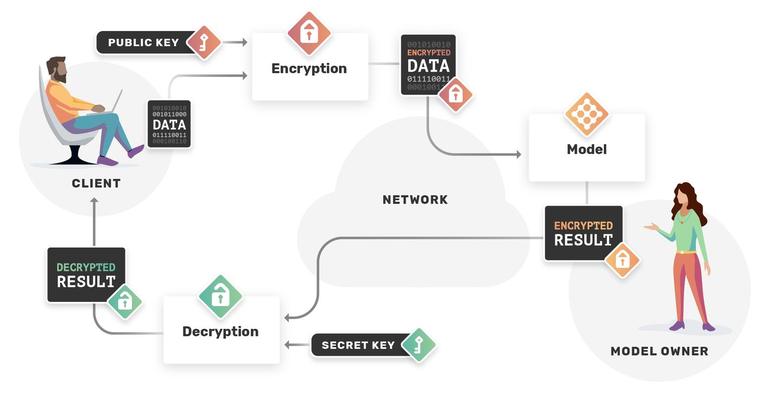
Biometric data is valuable and dangerous to share. Homomorphic encryption lets a buyer compute on it while the owner keeps the key.
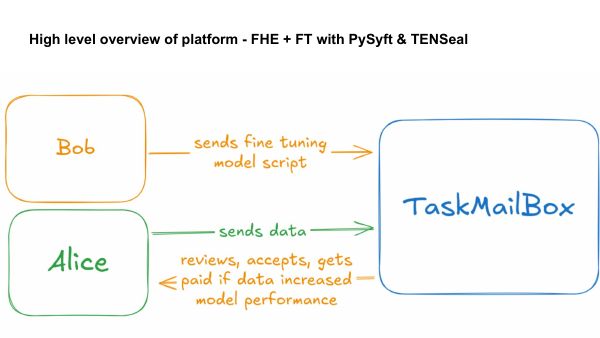
A bounty marketplace: buyers post data needs and CKKS parameters on-chain; owners encrypt locally with TenSEAL and approve each code request on their PySyft datasite.
Training runs on ciphertext. Only the owner decrypts the result, and the contract pays.
Deployed on the Polygon and Linea Sepolia testnets with a subgraph. Linea prize, and an invitation to the Linea Community Call.
Linea prize
One bounty
BountyPosted on-chain with the data spec and CKKS parameters.
EncryptThe owner encrypts on their own machine with TenSEAL.
DatasitePySyft hosts the ciphertext; the owner registers data scientists.
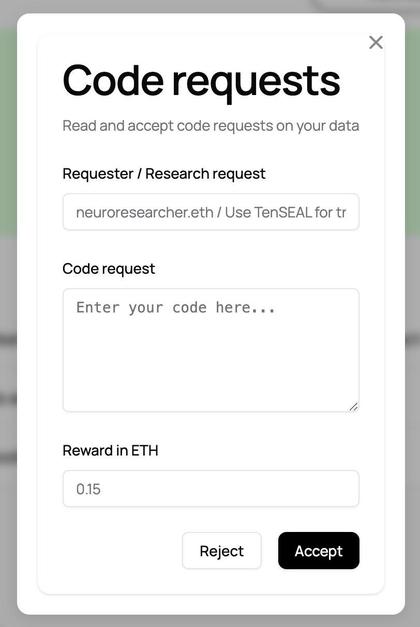
Code requestThe buyer submits code; the owner approves or rejects it.
Encrypted trainingThe model fits on ciphertext.
Decrypt and payThe owner decrypts the result; the contract releases payment.
Architecture Who holds keys, who holds ciphertext, who holds the model.Code request The owner accepts or rejects each run.
TenSEAL (CKKS)
PySyft
Threat modelling
Solidity
The Graph
Next.js
Docker
Linea
Dynamic
For an architectTrust boundaries drawn so the buyer never holds plaintext, even if the buyer is hostile.
For a data engineerEncrypted feature pipelines, and a working sense of what CKKS can compute and what it costs.
For a software engineerContracts, subgraph, web app and a Python service that ran end to end in 36 hours.
ETHGlobal Bangkok, November 2024. d/acc homomorphic is a marketplace for sensitive data. A buyer posts a bounty that states what data they need and which CKKS parameters to use. A data owner runs a PySyft datasite, encrypts the submission on their own machine with TenSEAL, and decides which code requests from data scientists may run. Training and evaluation happen on encrypted data. The owner decrypts the result, and the contract releases the payment.
Accounts use Dynamic, contracts run on the Polygon and Linea Sepolia testnets, a subgraph indexes the bounties, and the whole thing is a Scaffold-ETH monorepo with Docker. One stated goal was to let people who wear brain-computer interfaces, including people who use one as an accessibility device, earn from the data they produce while keeping ownership of it.
Universities publish good open hardware and stop at the paper.
Ocean Protocol research grant, $8,000: I surveyed open fNIRS hardware, wrote the paper and built NIRDuino from Vanderbilt's schematics with the Bowden Lab.
I ran the hardware QA myself, found hardware bugs and reported them back to Vanderbilt.
Collected the first public paired light-and-glucose dataset: near-infrared readings from the device next to continuous-glucose-monitor labels, each recording signed by the unit that made it.
Ocean Protocol Foundation research grant
Photons to dataset
SchematicsPublished open design, bill of materials, sourcing.
AssemblyManufacture, firmware, calibration.
Optical QABugs found and reported upstream.
CapturefNIRS sessions with continuous glucose monitor labels.
DatasetFirst public paired light-and-glucose data.
AttestDevice-signed recordings.
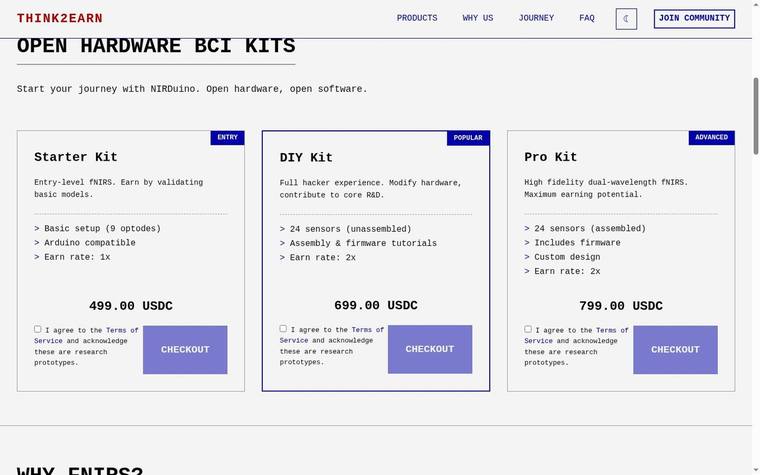
think2earn.com The NIRDuino kits as sold today: Starter, DIY and Pro.
Hardware QA
fNIRS optics
Data acquisition
Dataset design
Device attestation
Technical writing
For an architectThe whole stack from photons to payouts, and where the hardware is the weak link.
For a data engineerA labelled dataset designed before the model: sampling rate, baselines, paired ground truth, provenance per recording.
For a software engineerCapture and attestation tools that run next to real hardware.
With an Ocean Protocol Foundation research grant I surveyed the open-hardware fNIRS field, wrote a paper, and manufactured NIRDuino, a near-infrared spectroscopy device, from the DIY-fNIRS schematics published by Vanderbilt's Bowden Lab, in a formal collaboration with the lab. I ran the hardware QA, found hardware bugs and reported them back to Vanderbilt, collected optical brain data, and produced the first public paired light-and-glucose dataset. Recordings are signed so a dataset can be traced to a specific unit.
06SwitzerlandMay 2025 · Zuitzerland, a residency in the Alps
From raw light to a metabolic state
Can a cheap open fNIRS device tell fasting from fed? For the person it was trained on, yes.
A pipeline from NIRDuino raw intensities to HbO/HbR, 60-second epochs, statistical and FFT features, and a logistic regression under stratified 5-fold cross-validation.
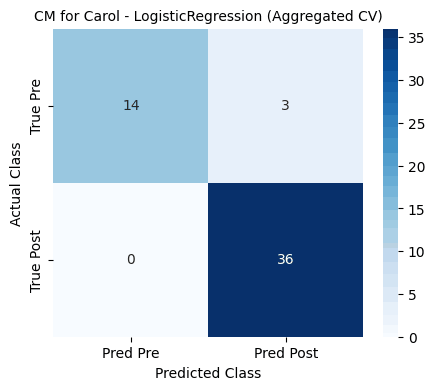
Within-subject accuracy 0.95, 0.96 and 1.00. Across subjects: 0.31 and 0.36. I report the second number because a payout system has to know it.
Logos prize for NFT-gated decryption on Codex storage, and a separate prize for the classifier.
Logos prizeNIRDuino classifier prize
0.95Carol · 5-fold CV
0.96Ron · 5-fold CV
1.00Rob · 5-fold CV
0.31cross-subject transfer
Fig. 1 ΔHbO (red) and ΔHbR (blue) per channel, one pre-meal session. From the submission notebook.Fig. 2 Cross-validation confusion matrix, subject Carol: 50 of 53 epochs correct.
The signal pipeline
Raw intensityTwo wavelengths, all channels.
ΔODLog ratio against a whole-signal baseline.
HbO / HbRModified Beer-Lambert law with the extinction matrix inverse.
Epochs60-second windows with 50% overlap.
FeaturesMean, standard deviation, skew, kurtosis, FFT power.
FitSelectKBest, then a class-balanced logistic regression.
EvaluateStratified 5-fold within subject, then across subjects.
scipy
scikit-learn
Signal processing
Cross-validation
NFT access control
Codex
Polygon Amoy
For an architectAccess control as a property of the data, not of a server.
For a data engineerThe full signal pipeline, cross-validation that respects the epoch structure, and a negative result stated plainly.
For a software engineerReproducible notebooks with saved artifacts, plus a working encryption gate.
Zuitzerland 2025, Logos prize and classifier prizeFigures above are from the submission notebook
Full story
Zuitzerland, May 2025. The notebook takes NIRDuino raw intensities, computes optical density change against a whole-signal baseline, applies the modified Beer-Lambert law to get oxygenated and deoxygenated haemoglobin, smooths, cuts 60-second epochs with 50% overlap, extracts statistical and FFT features per channel, selects features with an F-test, and fits a class-balanced logistic regression under stratified 5-fold cross-validation. Pre-meal versus post-meal, three subjects.
Within-subject accuracy was 0.95, 0.96 and 1.00. Applying one subject's model to the other two gave 0.31 and 0.36, which is worse than chance: metabolic fNIRS signatures do not transfer between people without calibration. The write-up says so.
At the same residency I built NFT-gated decryption for Codex storage: files that only wallets holding a seller-chosen NFT on Polygon Amoy can decrypt. That won the Logos prize.
07Berlin2025 · The Vault Berlin, an invited EigenLayer build · NEAR grant
Reward data by its marginal value
Paying for data attracts junk. Pay only for data that measurably improves the model.
The Vault Berlin, on EigenLayer's Hourglass AVS template: glucose-monitor and NIRDuino data, with on-chain proof that new data improved the model (blocked cross-validation).
NEAR Developer Rewards, Diamond tier, $17,500: Rust contracts where users stake and earn when their data provably improves performance.
A Data-Shapley scorer (FastAPI) prices each contribution by its marginal improvement; the next step moves it into a TEE for trustless scoring.
NEAR Diamond tier, $17,500The Vault Berlin, invited builder
One contribution
ContributeA user uploads glucose or fNIRS data.
AVS taskAn operator receives the evaluation job.
Blocked CVBaseline versus with-new-data, without leakage.
AttributionData-Shapley marginal value.
VerifyThe result is attested on-chain.
SettleStake released, reward paid.
Rust
NEAR contracts
EigenLayer AVS
Data-Shapley
Blocked CV
FastAPI
TEEs
Mechanism design
For an architectVerifiable evaluation as the settlement layer: the model's own improvement is the oracle.
For a data engineerAttribution and evaluation protocols that stay honest when money depends on the number.
For a software engineerRust contracts, Python scoring services and AVS operators in one flow.
At The Vault Berlin I was invited to build on EigenLayer's Hourglass AVS template. I collected continuous-glucose-monitor and NIRDuino data and proved on-chain that newly contributed data improved model performance, using blocked cross-validation so the gain is not leakage.
The NEAR Protocol Developer Rewards programme (Diamond tier, $17,500) funded the next step: Rust smart contracts for a staking mechanism where users lock funds and earn rewards when their data provably improves the model. Underneath sits a Data-Shapley scorer, a FastAPI service that prices each contribution by its marginal improvement, which is moving into a TEE-based agent for trustless scoring and payouts.
08CannesJul 2025 · ETHGlobal Cannes
Prove you were there, without saying where you were
A POAP ties your ENS name to a place and a time, on-chain, forever.
POAPrivacy mints attendance tokens to single-use stealth addresses (ERC-5564), registered under your ENS name (ERC-6538).
The keys come from a passkey: WebAuthn signs a fixed message and HKDF derives the spending and viewing keys. No private key is ever shown to the user.
Finalist (top 2%) and ENS Most Creative Use Case, 2nd place: $10k AWS credits plus $3,000.
Team of four. My part: the passkey-to-stealth key derivation, the address flow and its threat model.
ETHGlobal Cannes finalistENS Most Creative Use Case, 2nd
One claim
PasskeyA biometric WebAuthn signature over a static message.
HKDFDerives the spending key and the viewing key with ERC-5564 salts.
RegisterThe meta-address goes into the ERC-6538 registry, keyed by ENS.
MintThe issuer derives a fresh stealth address and mints the POAP there.
AnnounceAn ERC-5564 announcement with a view tag.
Scan and controlThe viewing key finds it; the spending key owns it.
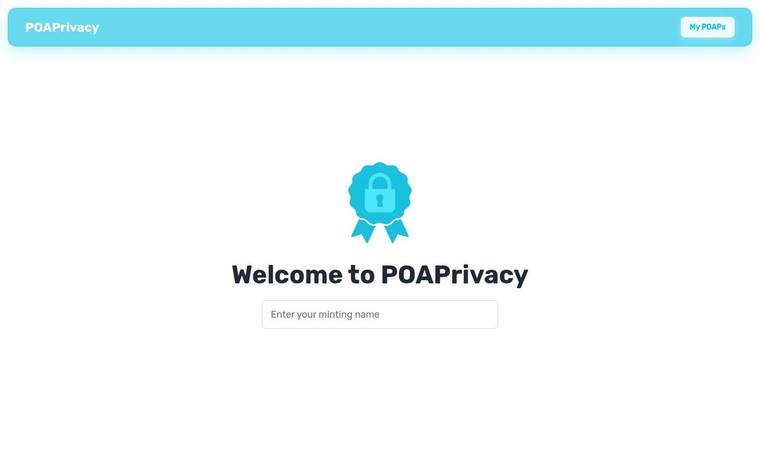
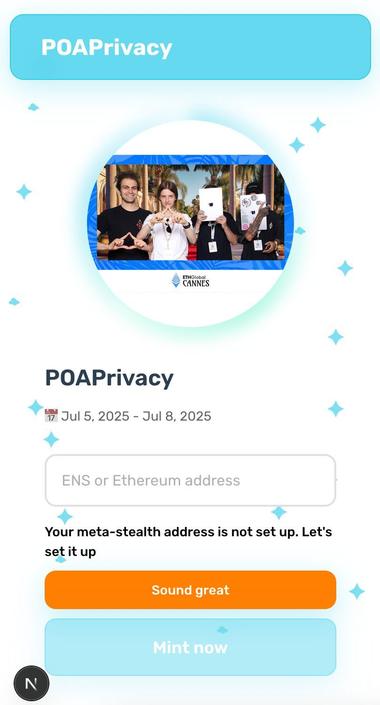
Live app ppoap.vercel.app, the claim page.Mint flow Choose an anonymous address or your ENS, then mint.
WebAuthn passkeys
HKDF
secp256k1
ERC-5564 · ERC-6538
Threat modelling
Next.js
Privy
POAP API
View-tag scanning
For an architectKey management that removes the key from the user experience: derived on the fly, never stored.
For a data engineerScanning announcements at scale, with view tags as a cheap pre-filter.
For a software engineerCryptographic primitives in TypeScript under a 36-hour clock, and a finalist stage demo.
POAPrivacy is a Next.js app built by a team of four at ETHGlobal Cannes in July 2025. A passkey signs a static message; HKDF derives the ERC-5564 spending and viewing keys from that signature, deterministically, so the same passkey always produces the same keys and nothing has to be stored. The stealth meta-address is registered in the ERC-6538 registry against the user's ENS name.
When the user claims a POAP, the issuer derives a fresh stealth address with an ephemeral key, mints the token there and publishes an announcement. The recipient scans announcements with the viewing key, discards most of them cheaply with the view tag, derives the spending key and controls the token. On-chain, the mint went to a random unlinked account. My part was the research and architecture of the passkey, key-derivation and stealth-address flow, and its threat model.
09Buenos AiresNov 2025 · ETHGlobal Buenos Aires
Proof of sleep, on the phone, in zero knowledge
Sleep trackers collect intimate data to reward you. Prove the outcome instead and keep the readings on the device.
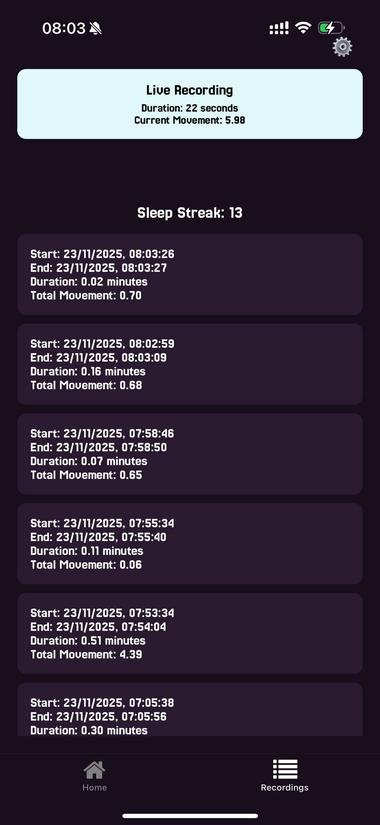
Eepy Cat reads the gyroscope on-device and scores movement through the night. At wake it generates a Groth16 proof (a Circom LessThan circuit) that the score stayed under the threshold.
snarkjs runs inside React Native with Node core polyfills. The proof goes through an Express relay and Curvegrid MultiBaas to a verifier on Base mainnet, which mints $EEPY.
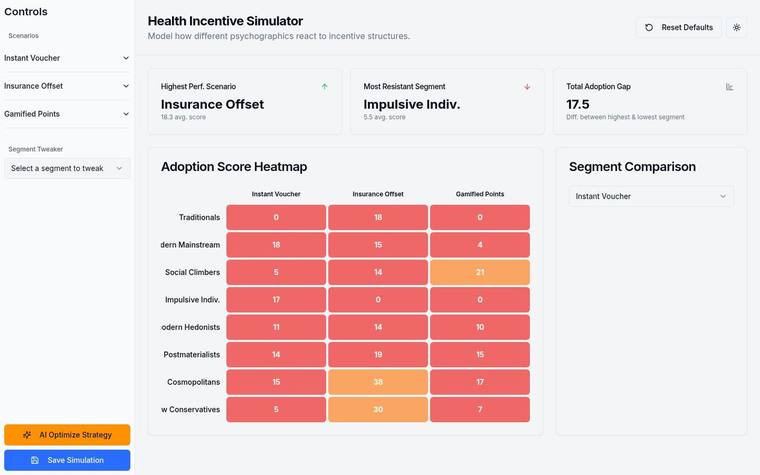
A Next.js simulator models user archetypes against incentive parameters, with a Genkit "AI economist". Curvegrid prize for best use of MultiBaas.
Team build at ETHGlobal Buenos Aires; the repository lives on a teammate's account.
Curvegrid: Best use of MultiBaas
One night
SenseGyroscope polling, on the device only.
ScoreAccumulated kinetic energy through the night.
ProveCircom LessThan circuit, Groth16 proof generated on the phone.
RelayExpress, then MultiBaas handles gas and nonces.
VerifyA Solidity verifier on Base mainnet checks the proof.
Reward$EEPY minted, streak updated.
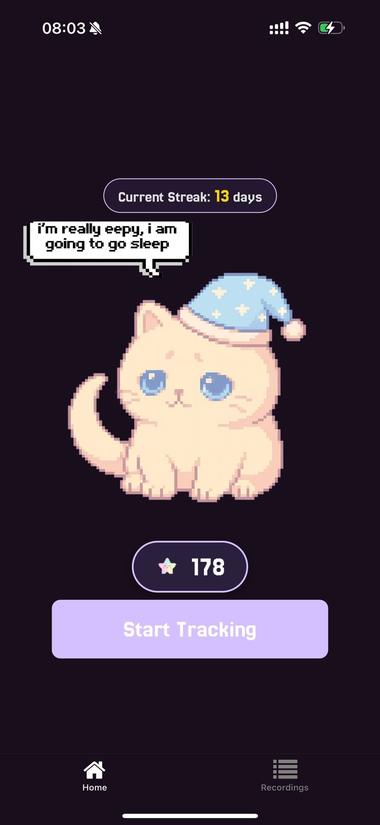
Home Streak and tokens; nothing leaves the phone.Recordings Sessions with duration and movement score.Simulator Adoption heatmap: user segments against incentive scenarios.
React Native / Expo
Circom
snarkjs · Groth16
Node polyfills in RN
Solidity · Hardhat
MultiBaas
Base
Incentive simulation
Next.js · Genkit
For an architectClient-side proving with a thin relay: the smallest trusted surface between a phone and a chain.
For a data engineerSimulating user segments against incentive parameters before collecting real data.
For a software engineerGetting a ZK prover to run inside React Native.
ETHGlobal Buenos Aires, November 2025. Eepy Cat is an Expo app that polls the gyroscope while you sleep and accumulates a kinetic-energy score on the device. At wake it generates a Groth16 proof from a Circom LessThan circuit: the private input is the movement score, the public input is the allowed maximum. snarkjs runs inside the React Native runtime, which meant polyfilling Node's crypto and buffer modules so WASM witness generation could run on the phone without freezing the interface. The proof goes to a small Express relay, then through Curvegrid MultiBaas to a Solidity verifier and a SleepRewardManager contract on Base mainnet, which mint $EEPY and update the streak.
The second half is a Next.js mechanism-design simulator. Psychographic archetypes, from the risk-seeking "100x Degen" to the complexity-averse "Traditional User", react to incentive parameters such as time preference, friction and risk appetite, and a Genkit model proposes parameter changes. The reward structure was tuned there before anyone earned a token.
10Santiago de Chile2025 · Primavera Hacker, a hacker festival · invited talk
Open medical hardware needs a different way to fund it
Primavera Hacker invited me to argue that open medical hardware and the way public money is allocated are one problem.
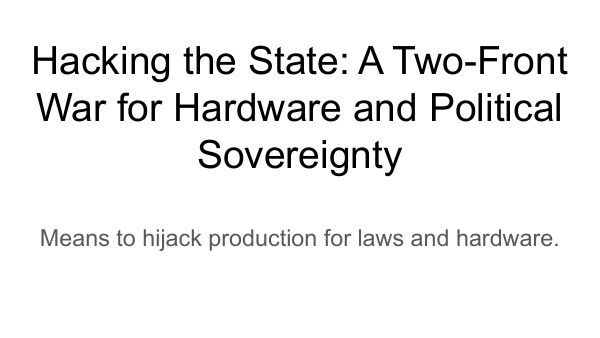
Talk: "Hacking the State: A Two-Front War for Hardware and Political Sovereignty", 55 slides.
The argument: new incentive systems for open medical hardware, with think2earn and NIRDuino as the case study.
Where public health money goes, how to fund hardware without a state budget, and coordination and legislation as engineering problems.
Invited speaker
The talk in six moves
ThesisDeath by aging will be solved; there are actions that bring it closer.
ResponseNew incentive systems, political coordination, open medical technology.
MotivationChronically online, rarely politically involved; public money not spent well.
MethodsWays to fix politics, from classical responses to paying for new parties.
Case studythink2earn and NIRDuino: open hardware raises competition.
CoordinationCybernetics and legislation, and new money for hardware.
Title slideSlide 32 Platform overview: encrypted training with PySyft and TenSEAL.
Public speaking
Mechanism design
Open-hardware policy
Coordination
For an architectSystems thinking applied to institutions: incentives, feedback loops, legislation.
For a data engineerAn argument built from figures about where public money goes.
For a software engineerExplaining hard technical ideas to a room that does not write code.
Slides (PDF)Primavera Hacker, Santiago de Chile, 2025
Full story
Primavera Hacker is a hacker festival in Santiago de Chile. In 2025 I gave a talk there titled "Hacking the State: A Two-Front War for Hardware and Political Sovereignty". The thesis is that solving death by aging needs open medical technology, and open medical technology needs new incentive systems and political coordination. The talk covers why taxes are not spent ideally, methods to fix politics, think2earn as a case study, new forms of money for hardware, and coordination, cybernetics and legislation as one problem.
11Prague2024 → 2026 · think2earn, home base
The systems that run think2earn
Running think2earn solo: AI coding agents draft, and I own the architecture, the review, the tests and what ships.
Production on AWS: Lambda, Firecracker microVMs, Fargate, S3, IAM, CloudWatch. Linux servers, Docker, Nginx and Caddy, TLS automation, CI/CD, signed Android releases.
The chat control plane below: one API, three execution lanes, a turn journal that web and mobile both read, a usage ledger settled on every done frame.
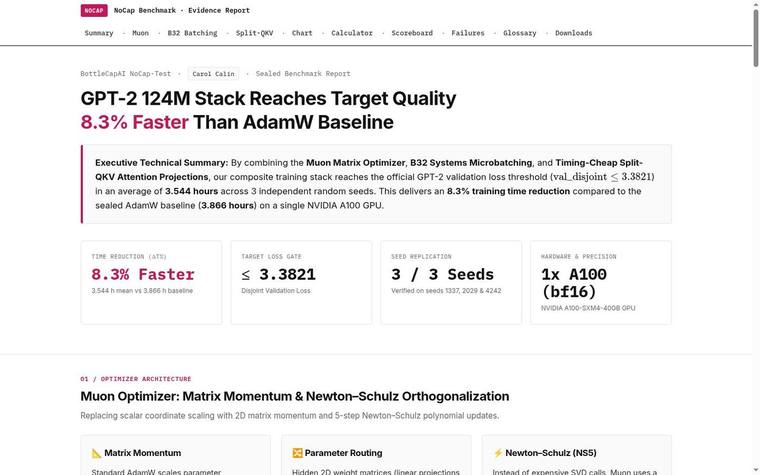
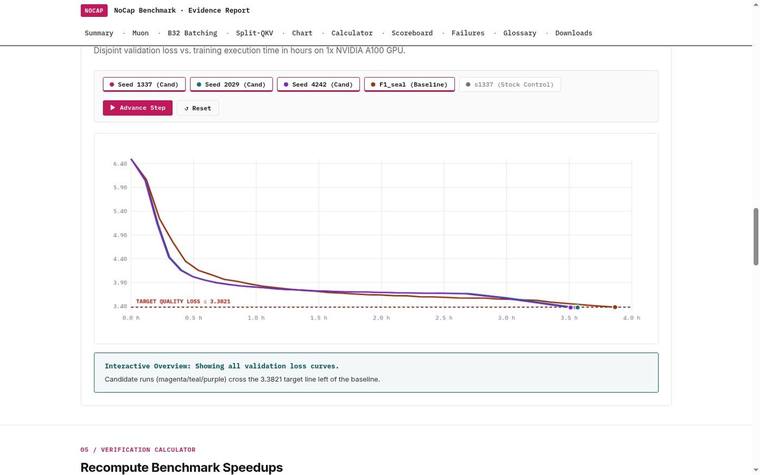
NoCap benchmark: GPT-2 trained on FineWeb with the Muon optimiser, microbatch packing and split-QKV, published with a failure ledger. 2026 grants: Hyperagent Founding 500 ($20k credits) and Thinking Machines Lab ($5k credits).
Hyperagent Founding 500Thinking Machines Lab grant
How the shop works
SpecProblem, plan, acceptance checks.
Agents draftClaude Code, Gemini, Devin and Cursor in sandboxes; I review and test.
MicroVMsIsolated execution, ephemeral by default.
PipelinesLambda, Fargate, S3, infrastructure as code, CI/CD.
EvidenceBenchmarks with logs and a failure ledger.
ReleaseSigned builds, TLS, monitoring.
Data engineering inside think2earn
Turn journal: every event of every turn is appended to a journal that web and mobile both read, so a client can reconnect and resume mid-turn and any turn can be replayed.
Usage ledger: tokens and credits are recorded on the done frame, in the same step that releases the turn lock, so billing and state never disagree.
Storage layout: 20 DynamoDB tables for conversations, messages, journal and ledger; S3 for artifacts and staged turn inputs; one Postgres database per tenant on Aurora Serverless v2.
Training data: FineWeb tokenised and packed into fixed 524,288-token steps for the NoCap run; the NIRDuino light-and-glucose dataset paired and signed per recording (project 05).
NoCap report Headline result and metrics, nocap.think2earn.com.Loss curves Three seeds against the baseline, target line marked.
AWS Lambda · Fargate · S3
Firecracker microVMs
DynamoDB · Aurora Postgres
Event journal · ledger
Linux · systemd
Docker · Nginx / Caddy
CI/CD · release signing
GPT-2 on FineWeb
Muon optimiser
Benchmark design
For an architectControl planes, isolation and cost attribution as daily work. See the architecture section below.
For a data engineerAn append-only turn journal, a ledger settled transactionally, per-tenant Postgres, and training pipelines that publish their evidence.
For a software engineerInfrastructure, CI/CD and signed releases for real users, maintained solo.
Since 2024 think2earn has been my day job, as a solo founder working with AI coding agents (Claude Code, Gemini, Devin, Cursor). The agents draft; I own the architecture, review every change, write the acceptance checks and decide what ships. I run the production infrastructure on AWS: Lambda functions, Firecracker microVMs, Fargate, S3, IAM and CloudWatch, with Linux servers on Ubuntu and Debian, systemd, hardened SSH, Docker, Nginx and Caddy reverse proxies, automated TLS certificates, GitHub CI/CD and cryptographically signed Android releases.
For the NoCap benchmark I trained GPT-2 on the FineWeb dataset and published an evidence report: the Muon optimiser with matrix momentum and Newton-Schulz orthogonalisation, microbatch packing for A100 occupancy, split-QKV projections, and a failure ledger of the approaches that were rejected and why. Two 2026 grants fund the next stretch: the Hyperagent Founding 500 for engineering with containerised frontier models, and a Thinking Machines Lab researcher grant for fine-tuning and RLHF of "mirrored-self" agents.
12The Harbouronline competitions
Two leaderboard results on hidden test data
Two competitions had no city. Grants are listed once, in the ledger below.
3rd of 12,000+ participants in a repository risk and impact modelling challenge sponsored by the Ethereum Foundation: codebase evolution, maintainer dynamics and dependency risk of core Ethereum repositories, predicting hidden jury data. $3,000.
EigenLayer Vibescore prediction: predictive models for software-verifiability infrastructure, highest prize on the leaderboard. $3,000.
Grants (Ocean Protocol, NEAR, Hyperagent, Thinking Machines Lab) belong to projects 05, 07 and 11 and are listed in the ledger.
3rd of 12,000+Vibescore leaderboard, highest prize
Predictive modelling
Repository analysis
Feature engineering
For an architectReading a codebase's health from its history: maintainers, dependencies, churn.
For a data engineerTwo leaderboard results on hidden test data.
For a software engineerModels that had to run, score and submit on a deadline.
One message, seven steps web and mobile clients · one API · three execution lanes on AWS
think2earn chat is a multi-tenant agent runtime. Two clients, one API, and three ways to run a turn depending on how much autonomy and isolation it needs. Press Send a message to follow one request through the system.
3execution lanes, chosen per turn
1public entry point: a Cloudflare tunnel
20DynamoDB tables, plus S3 and Aurora Postgres per tenant
2clients on the same event journal: web and Expo mobile
Idle
You send a message.
From the web app or the phone. Both use the same API; the phone never talks to AWS directly and stays logged in for 30 days.
Technical
POST /api/chats/:id/messages { content, agentMode, modelId }. Web: 12-hour session cookie. Mobile: bearer JWT, reissued on GET /api/me.
The gate is the only door.
A Cloudflare tunnel is the single public entry. The control plane checks the session, then the organisation's membership and remaining credits.
Technical
Tunnel → Express on EC2 (localhost only) → AuthService.verify(cookie | bearer) → DynamoDB lookup of org and credits. No public AWS endpoints.
The lane router picks how the turn runs.
Fast: a small model on the same machine. Normal: the managed agent runtime with tools, streamed. Cloud: long autonomous work in an isolated worker with its own filesystem and budget. One API, chosen per turn.
Fast and Normal stream tokens back live. Cloud returns a request id and the client polls the turn journal. Web and mobile read the same journal, so a phone can lock, reconnect and resume mid-turn.
Technical
SSE 200 for fast and normal (chunk, plan_update, metadata, done). 202 { requestId } for cloud; GET …/turns/:requestId/events?after=seq every 2 s, 5 s after 30 s. Every event is journaled.
Tools run in sandboxes.
Code runs in a Python sandbox, browsing in a browser worker. Files they produce land in object storage and appear in the UI as artifacts.
Technical
Tool call → code-interpreter runtime (stdout and files) or browser worker → S3 artifact bucket → artifact dock event to the client.
State is boring on purpose.
Conversations in DynamoDB, artifacts in S3, each project's data in its own Postgres database. A turn lock stops a retried request from running twice, and the reply is saved before the done frame goes out.
Technical
20 DynamoDB tables (conversations, messages, usage ledger, turn journal…), S3 for artifacts, Aurora Serverless v2 with a Postgres database per tenant, turn lock and updatedAt on the conversation row.
Settle the turn.
On the done frame the ledger records tokens and debits credits, the lock is released and follow-ups are attached. Every turn is accounted for the moment it finishes.
Latency, cost and autonomy are a per-turn trade-off. Clients state intent; the router picks the runtime.
02 · Single entry
Nothing in the cloud account is public. One tunnel, one auth path, one place to look.
03 · Journal, then stream
Streaming is delivery. The journal is the truth, which makes resume, audit and replay free.
04 · Isolation for long work
Autonomous turns get their own worker, filesystem and budget. A runaway task cannot take the control plane down.
05 · Meter at the done frame
Usage is recorded when the turn settles, together with the lock release, so billing and state agree.
RecordPrizes, grants and residencies
13 prizes · 4 grants · 3 residencies · 1 invited talk hover a station on the timeline for the detail
$38.5k+cash prizes and grants
$35kcompute credits
5prizes without a disclosed amount
3residencies and fellowships
Year
What
Where
For
Type
Amount
2026
Hyperagent Founding 500
remote
Engineering with containerised frontier models and harnesses
grant
$20k credits
2026
Thinking Machines Lab researcher grant
remote
Fine-tuning and RLHF for "mirrored-self" agents
grant
$5k credits
2025
NEAR Developer Rewards, Diamond tier
remote
Staking mechanism: rewards when contributed data provably improves a model
grant
$17,500
2025
ETHGlobal Cannes: finalist (top 2%) and ENS 2nd place
Cannes
POAPrivacy: passkey-derived stealth addresses for private proof of attendance
2 prizes
$10k AWS + $3,000
2025
Repository risk and impact modelling, 3rd of 12,000+ participants
online
Codebase evolution, maintainer dynamics and dependency risk of Ethereum core repositories; sponsored by the Ethereum Foundation
prize
$3,000
2025
EigenLayer Vibescore prediction
online
Predictive models for software-verifiability infrastructure; highest prize on the leaderboard
prize
$3,000
2025
ETHGlobal Buenos Aires, Curvegrid prize
Buenos Aires
Eepy Cat: proof of sleep with on-device Groth16 proofs
prize
—
2025
Primavera Hacker, invited talk
Santiago de Chile
"Hacking the State": open hardware and how public money is allocated, think2earn as case study
talk
—
2025
Zuitzerland: Logos prize and classifier prize
Switzerland
NFT-gated decryption for Codex storage; fNIRS metabolic state classifier
2 prizes
—
2025
The Vault Berlin, invited builder
Berlin
EigenLayer Hourglass AVS: on-chain proof that new data improved the model
residency
—
2024
Ocean Protocol Foundation research grant
remote, Vanderbilt collaboration
Open fNIRS hardware survey, NIRDuino manufacture, first public paired light-and-glucose dataset
grant
$8,000
2024
ZuVillage Georgia: Best Startup and Best Idea
Georgia
EEG collection frontend and open-hardware BCI business plan; the start of think2earn
2 prizes
$3,000
2024
ZuThailand fellowship: EZKL prize and honorable mention
Chiang Mai
End-to-end zero-knowledge ML pipeline over an fNIRS model
2 prizes + fellowship
—
2024
MegaZU builder residency
Chiang Mai
EigenLayer and MegaETH residency; fNIRS attestations, federated HE experiments
residency
—
2024
ETHGlobal Bangkok, Linea prize
Bangkok
d/acc homomorphic: encrypted federated training marketplace; invited to the Linea Community Call
prize
—
2024
ETHDam, Waku prize
Amsterdam
Data bounty marketplace with decentralised messaging
prize
$1,000
SkillsSkills, with the evidence
Click a skill and the map shows where it was used, with a one-line proof and a link to the project.
Systems architect
I draw trust boundaries first: who holds plaintext, where isolation happens, what gets verified instead of trusted, and how cost is attributed per tenant and per turn. I have designed and run a multi-lane agent control plane on AWS and privacy architectures built on ZK proofs, homomorphic encryption and stealth addresses.
Data engineer
I build the pipelines that move and evaluate sensitive data: an append-only event journal and a transactional usage ledger in production, per-tenant Postgres on Aurora, sensor pipelines from raw fNIRS and EEG signal to leakage-safe evaluation, data attribution with Shapley values, and training runs that publish their evidence, including the negative results.
Software engineer
I ship across the stack: Python services, TypeScript and React Native apps, Rust and Solidity contracts, Linux and AWS infrastructure with CI/CD and signed releases. I have made a ZK prover run inside React Native and kept a production chat backend up as a solo founder.
WritingThree essays
think2earn.substack.com why the hardware must be open, why the data must be yours
April 2025
The Cognitive Sovereignty Manifesto
Your cognitive data stream, the electrical and metabolic echoes of your consciousness, is not byproduct data to be harvested.
Like Bitcoin or Ethereum consensus rewards, except the network is kept alive by paying people to design, manufacture and build with open-hardware brain-computer interfaces.